12 min read
The 12 Resume Mistakes Recruiters Reject in 2026 (With Real Statistics)
May 28, 2026 · ResuAI Editorial
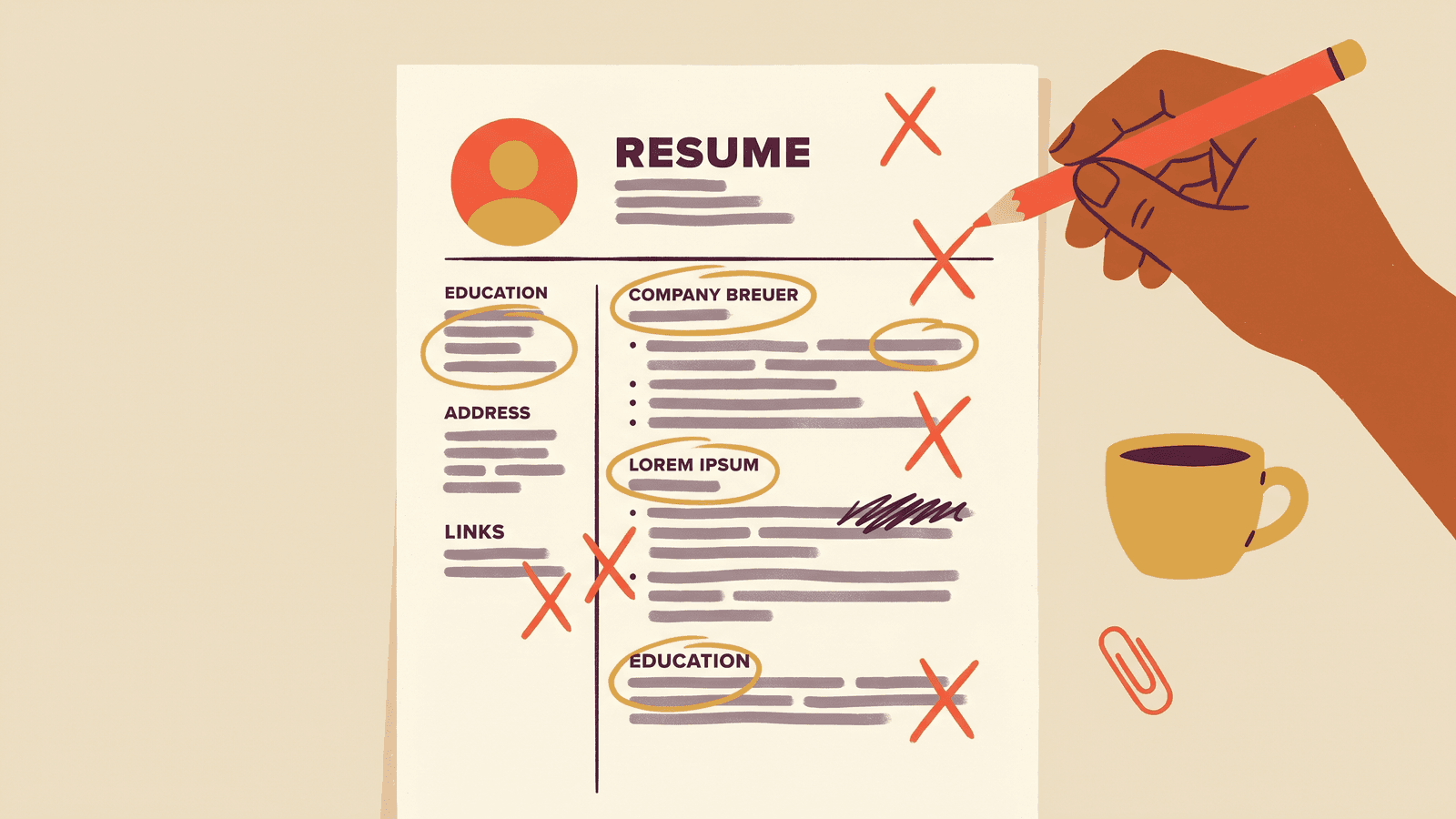
The honest baseline: only ~2% of submitted resumes result in an interview (per The Interview Guys' 2026 analysis). 94.3% of job seekers report getting completely ghosted by employers (United Way 2026 survey). The funnel is brutal, and most "I didn't even get a callback" stories aren't bad luck — they're recruiters making fast pattern-match rejections on resumes that fail one of a handful of specific tests.
Most "resume mistakes" listicles are recycled from 2014: don't use Comic Sans, don't lie about your degree, don't have a typo in your name. These aren't useful because nobody is doing them at scale anymore — though 77% of hiring managers still admit they'd dismiss a resume with bad grammar (standout-cv.com 2026 stats), so don't get cocky.
What recruiters actually reject in 2026 is more interesting. We've been collecting the reasons from a rotating group of ~30 recruiters and hiring managers we talk to weekly — people who run 50+ screens a month at SaaS, fintech, healthcare, and consumer-product companies. Below are the 12 patterns that come up most often. Each one has a fix.
1. Bullets that describe a job, not a person
This is the single biggest one, and it shows up on probably 80% of resumes that get rejected.
Looks like: "Responsible for managing a team of 8 engineers." "Worked on the company's marketing strategy." "Helped customers with technical issues."
Why it's rejected: Every candidate could write these bullets. They describe the JD that existed, not what you did. The recruiter can't differentiate you from the 11 other people who held the same title.
Fix: Apply the Verb · Impact · Method formula from our achievement bullets guide. Every bullet needs a verb, a number, and the how. "Managed a team of 8 engineers" becomes "Grew the platform engineering team from 4 to 8 in 14 months while keeping regretted-attrition at 2%, by implementing a structured promotion ladder and biweekly career conversations."
2. The Skills section that lists 47 things
Looks like: A "Skills" section with a wall of comma-separated entries: "Microsoft Office, Excel, Word, PowerPoint, Outlook, JIRA, Confluence, Asana, Trello, Notion, Slack, Microsoft Teams, Zoom, Google Workspace, Photoshop, Illustrator, Figma, SQL, Python, R..."
Why it's rejected: The recruiter reads this as "this person doesn't know what's important." The skills you list are also a promise — every one of them is fair game in a technical screen. Listing 47 means you've promised to be probable on 47, and you're not.
Fix: Cut to 8-15 skills, each one you could defend in a 5-minute conversation. Group them if it helps (e.g., "Languages: Python, Go, SQL | Tools: dbt, Airflow, Looker | Cloud: AWS, GCP"). Quality over coverage.
3. The "Objective" that says nothing
Looks like: "Seeking a challenging position at a forward-thinking company where I can grow my skills and contribute to the team's success."
Why it's rejected: Could be on every resume on the planet. Carries no information about you, the candidate. Reads as an artifact of a 2008 resume template.
Fix: Either delete it entirely (most candidates), or replace it with a real summary that does the work of a summary (see our resume summary guide). The objective format is dead; nobody is asking what you're "seeking."
4. Buzzword adjective stacking
Looks like: "Passionate, results-driven, innovative, strategic thinker with strong communication skills and a proven track record of driving success in fast-paced environments."
Why it's rejected: Every adjective is unfalsifiable and recycled. The whole sentence could be on a resume in any function. Recruiters mentally delete the line and look for the next one with information.
Fix: Strike every adjective. Each adjective should be replaceable with a fact. "Passionate" → name the specific work you've done that proves it. "Results-driven" → show the result. "Strong communication skills" → reference the body of writing or talks you've done.
5. Dates that are vague or out of order
Looks like: "Summer 2022 - Present", "2019-2020 (returned 2022)", or roles listed in non-chronological order.
Why it's rejected: The recruiter loses 3-5 seconds figuring out the timeline, which is 30-50% of the budget they had for your resume. They move on to a candidate whose dates are clear.
Fix: Always "MMM YYYY – MMM YYYY" (e.g., "Mar 2022 – Sep 2024") or "MMM YYYY – Present". Strict reverse chronological. If you returned to a previous employer, list it twice (it's not a red flag — it's a strong signal that they wanted you back).
6. Missing keywords from the JD
Looks like: A resume that's strong but never says the words the JD said. JD asks for "experience with Snowflake"; resume mentions "data warehouse" but never Snowflake by name.
Why it's rejected: Both the ATS scoring layers (keyword + semantic) and the recruiter's text-search-on-the-resume score this down. Even if you've done the equivalent work elsewhere, the search query doesn't surface you.
Fix: Tailor for each application. Read the JD, identify the 8-12 keyword tokens (skills, tools, certifications), and make sure each one appears in at least one bullet — naturally, in context of work you actually did. If you've never used Snowflake but you've used BigQuery, don't pretend you have — but make sure BigQuery is on the resume so the semantic match catches it.
7. Bullets that wrap to 3 lines
Looks like: "Led the strategic redesign of the customer onboarding experience, including extensive collaboration with product, engineering, and design stakeholders across 4 product squads, resulting in significant improvements to user activation and retention metrics over a 9-month period as well as deeper organizational alignment around the customer journey."
Why it's rejected: A 3-line bullet means you're rambling. The recruiter's eye gives up halfway through. Even when the underlying work was impressive, the writing buried it.
Fix: One line max. Each bullet should sit on one printed line at standard margins. If it's wrapping, you have too many clauses — cut to the core verb-impact-method and remove the editorializing. "Led the redesign of the customer onboarding flow (8 screens → 4), lifting D1 retention from 38% to 51% across 4 product squads."
8. Education and Skills at the top of page 1
Looks like: Education section above the work experience section on the first page. Common in templates marketed to recent grads, but spreading to mid-career resumes.
Why it's rejected: The recruiter is looking for current work experience first. Putting Education on top forces them to scroll past it, which costs 2-3 seconds of their attention budget — and many recruiters will assume you're hiding weak work experience behind a degree.
Fix: Education goes at the bottom unless you're a current student or graduated within the last 12 months. Even then, work experience first is usually still right.
9. "References available upon request"
Looks like: This exact line at the bottom of the resume.
Why it's rejected: It's the universally-assumed default. Including it signals "I'm following a 2010 resume template I found online" rather than "I know what hiring is like in 2026."
Fix: Just delete the line. Recruiters know they can ask for references.
10. The "personal interests" section nobody asked for
Looks like: "Hobbies: Hiking, cooking, reading, traveling, spending time with family."
Why it's rejected: Carries no information. Doesn't differentiate you. Wastes a line on a resume already competing for 30 seconds of attention.
Fix: Delete unless you have one specific personal interest that's directly relevant or genuinely interesting (e.g., "Maintains a 2,400 ELO chess rating on Lichess" — yes, that's interesting; "Enjoys reading and travel" — no). For 95% of resumes, delete the section.
11. Inconsistent formatting (the small one that adds up)
Looks like: Some bullets end with periods, others don't. Some dates are "May 2023", others "5/2023". Some titles are bolded, others italicized. Some bullets have a leading space after the bullet character, others don't.
Why it's rejected: It signals carelessness on a document that's supposed to demonstrate care. The recruiter doesn't consciously notice each inconsistency, but the cumulative impression is "this person doesn't polish their work."
Fix: Pick a convention and apply it everywhere. Either all bullets end with periods or none do. Either all dates are "MMM YYYY" or all are "MM/YYYY". One pass through the resume to normalize takes 5 minutes and lifts perceived quality measurably.
12. AI slop that's recognizably AI
Looks like: Smooth prose, no specifics, faintly corporate tone in every bullet. Every line ends with a participial phrase. Adjectives like "robust", "scalable", "innovative" appear in almost every bullet. No verbatim names of tools, companies, or numbers.
Why it's rejected: Recruiters are seeing this pattern explode in 2025-2026 and many are actively filtering for it. A resume that "sounds like ChatGPT wrote it" gets treated as "this candidate didn't put real effort in", regardless of whether the underlying work was good.
Fix: Use AI to help you find the right number, the right verb, the right tool name — but don't ship LLM-generated prose verbatim. Each bullet needs a falsifiable specific: a dollar figure, a customer name, a product name, a date range. If a bullet could be on someone else's resume in the same function, rewrite it with the specifics that anchor it to you.
Putting it all together
These 12 are the rejection patterns we see most often. The fix for almost all of them is the same: specificity + signal density. A resume that's specific (named tools, named customers, real numbers) and signal-dense (every line carries information the recruiter couldn't infer from the title) gets read in full. Most rejection is just the recruiter running out of attention before getting to anything that mattered.
Run the resume through our analyzer for a per-bullet specificity check and a match score against the target JD. Most resumes gain 10-20 points just by fixing the 12 patterns above.

Written by
ResuAI Editorial
ResuAI's in-house editorial team reads 200+ job descriptions a week to keep our analyzer (and these guides) sharp.
We're the small team that builds, breaks, and re-tunes the ATS scoring engine, the resume builder templates, and the analyzer's bullet rewrites. Everything we publish is grounded in what real recruiters and ATS systems actually do today -- not the conventional wisdom that's been recycled since 2014.
Try this on your own resume
Run your resume + the JD through the analyzer for a match score, missing keywords, and bullet rewrites.
Analyze my resumeKeep reading
More from the career hub
14 min read
Account Executive Resume Examples: Quota, ACV, Pipeline, and Proof
Build an account executive resume that proves quota attainment, deal size, segment, sales cycle, pipeline ownership, and sales-stack fluency.
13 min read
Career-Change Resume Examples: 7 Before-and-After Pivots
Seven career-change resume examples with weak before bullets, translated after bullets, and a clear explanation of why each rewrite works.
7 min read
Skills to Put on a Resume in 2026: What 1,005 Hiring Managers Actually Want
New survey data from 1,005 U.S. hiring managers on the hard and soft skills that matter in 2026 — and the 8-slot rule that beats every 47-skill list.