9 min read
How to Use AI to Write Your Resume (Without It Sounding Like a Robot)
June 23, 2026 · ResuAI Editorial
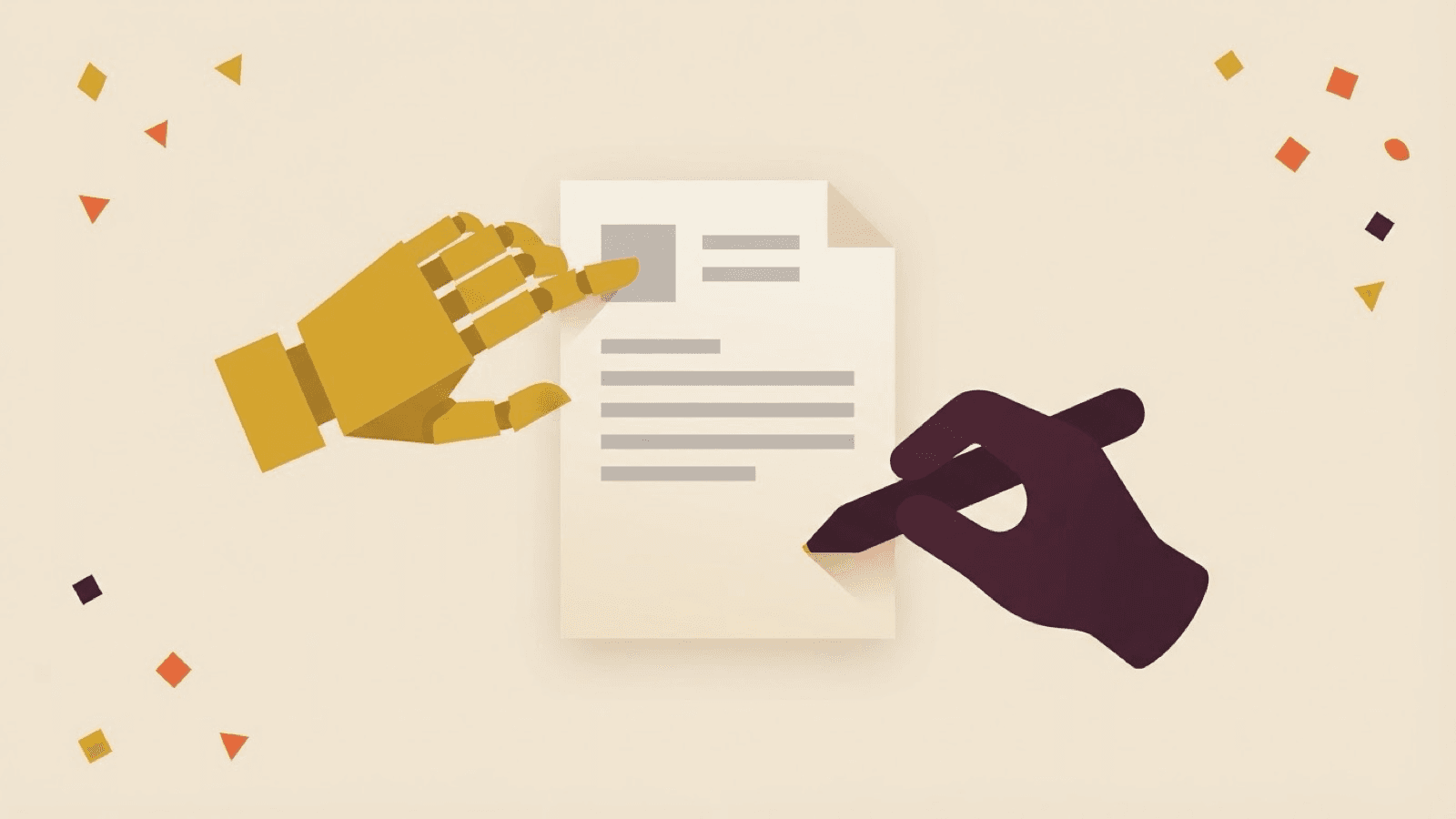
Ask a chatbot to "write me a resume" and you'll get something back in eight seconds. It will be grammatically perfect, confidently formatted, and completely useless. It will say you are a "results-driven professional with a proven track record of leveraging synergies." No recruiter has ever read that sentence and scheduled an interview.
The problem isn't AI. The problem is asking AI to do the part only you can do — and skipping the part it's genuinely great at. Used the right way, AI cuts resume-writing from a dreaded weekend to a focused hour. Used the lazy way, it produces a document that gets auto-rejected by both the ATS and the human behind it.
Here's the division of labor that actually works.
What AI is genuinely good at
Lean on AI for the mechanical, time-sucking parts of resume writing:
- Restructuring a messy bullet. You paste "I was in charge of the team that did the migration thing and it went well," and ask it to rewrite as an action-verb → result bullet. It will give you a clean skeleton you then load with real numbers.
- Surfacing keywords you're missing. Paste a job description and ask which skills and terms it emphasizes. This is the same gap analysis behind tailoring a resume to a JD — AI just makes the extraction faster.
- Tightening wordy lines. "Responsible for the coordination and management of cross-functional stakeholders across multiple departments" → "Coordinated 4 departments on the launch." AI is excellent at compression.
- Generating a first-draft summary you'll then rewrite. A blank page is the enemy; a mediocre draft you can react to is progress. (See how to write a resume summary for the formula to react against.)
- Fixing tone and consistency — tense, parallel structure, Oxford commas, US vs UK spelling.
Notice the pattern: AI is good at transforming text you give it. It's bad at inventing the substance.
What AI is dangerously bad at
This is the 20% you must own, because AI will confidently fake all of it:
- Your numbers. AI does not know that you cut churn 1.9 points or closed $2.4M in ARR. If you let it guess, it will invent plausible-sounding metrics — and "increased efficiency by 40%" with no mechanism behind it is a red flag every experienced recruiter recognizes. Every number on your resume has to be one you can defend in the interview.
- Your judgment about what matters. AI weights everything you give it roughly equally. It can't tell that your migration project matters more for this role than your hackathon win. That prioritization — what goes in the top third of page one — is the highest-value decision on the whole document, and it's yours.
- Your voice. AI defaults to corporate beige. Two candidates who both "leveraged cross-functional synergies" are indistinguishable. The specific, slightly-human phrasing is what makes you memorable.
- The truth. This is the big one. AI will happily write that you're "proficient in Kubernetes" because the JD asked for it. If you're not, you've just scripted your own technical-screen disaster.
The hour-long AI resume workflow
Here's the repeatable process. Set aside an hour.
Step 1 — Brain-dump your raw material (15 min, no AI)
Before you touch a chatbot, write down — messily, in any format — every project, responsibility, and result from each role. Don't write resume bullets. Write facts:
"Ran the email program. Iterable. ~22 step sequence. We A/B tested it. Trial-to-paid went from like 11% to 17% over about 9 months."
This raw material is the thing AI cannot generate. Everything good downstream depends on it.
Step 2 — Have AI shape bullets from your facts (15 min)
Now paste your raw facts and prompt:
"Turn each of these into a single resume bullet. Use the structure: strong action verb → what I did → quantified result. Keep my numbers exactly as written. Don't invent any metrics. Don't use the words 'leveraged', 'spearheaded', or 'results-driven'."
That last sentence matters. Banning the buzzwords up front saves you a cleanup pass. You'll get back something like:
"Scaled the lifecycle email program (Iterable, 22-step behavioral sequence) through quarterly A/B testing, lifting trial-to-paid conversion from 11% to 17% over three quarters."
Real numbers, clean structure, no robot smell. (For more on what separates a strong bullet from a weak one, see achievement bullets that prove impact.)
Step 3 — You prioritize and cut (15 min, no AI)
AI gave you raw bullets. Now you decide the order, what to keep, and what to delete. Put the most role-relevant, highest-magnitude bullets first under each job. This is judgment work — don't outsource it.
Step 4 — Tailor with AI, verify with a tool (15 min)
Paste the target job description and ask AI which of its key terms are missing from your draft. Promote the ones you can honestly back up. Then — critically — don't trust the chatbot's opinion of whether you're a match. Run the result through a resume analyzer that scores you against the actual JD and shows the real keyword gaps. AI's self-assessment is a vibe; a scoring tool is a measurement.
The five tells that out an AI-written resume
Recruiters and good ATS parsers both pick up on these. Hunt them down before you submit:
- Buzzword density. "Results-driven," "proven track record," "leveraged," "spearheaded," "synergy." One is forgivable. Four in a summary is a confession.
- Metrics with no mechanism. "Improved performance by 35%." Improved what, how? Real metrics name the lever.
- Uniform bullet length. AI loves to make every bullet the same tidy 18 words. Humans vary. A little unevenness reads as authentic.
- Skills you can't defend. If the JD said it and your resume now claims it but your stories don't support it, cut it.
- The em-dash-and-tricolon rhythm. AI has a tell: "strategic, scalable, and sustainable." If three of your bullets use the same triple-adjective cadence, break it up.
Where this leaves you
The candidates who lose to AI are the ones who let it write the whole thing. The candidates who win use it as a fast, tireless editor — and keep ownership of the facts, the priorities, and the voice.
That's exactly the split ResuAI is built around: the analyzer and ATS score tools do the mechanical scoring and gap-finding in seconds, and the builder gives you the structure — but the substance stays yours. The AI handles the 80% that's tedious so you can spend your energy on the 20% that gets interviews.
The TL;DR
- Brain-dump raw facts first, with real numbers, before opening any AI tool.
- Use AI to shape bullets and compress wordy lines — never to invent metrics.
- You own prioritization, voice, and truth. Don't outsource judgment.
- Ban the buzzwords in your prompt ("don't use leveraged / spearheaded / results-driven").
- Verify the result with a scoring tool, not the chatbot's opinion of itself.
Used this way, AI doesn't make your resume sound like a robot. It gives you back the hours you'd have spent fighting a blank page — and a document that still sounds like you.

Written by
ResuAI Editorial
ResuAI's in-house editorial team reads 200+ job descriptions a week to keep our analyzer (and these guides) sharp.
We're the small team that builds, breaks, and re-tunes the ATS scoring engine, the resume builder templates, and the analyzer's bullet rewrites. Everything we publish is grounded in what real recruiters and ATS systems actually do today -- not the conventional wisdom that's been recycled since 2014.
Try this on your own resume
Run your resume + the JD through the analyzer for a match score, missing keywords, and bullet rewrites.
Analyze my resumeKeep reading
More from the career hub
14 min read
Account Executive Resume Examples: Quota, ACV, Pipeline, and Proof
Build an account executive resume that proves quota attainment, deal size, segment, sales cycle, pipeline ownership, and sales-stack fluency.
13 min read
Career-Change Resume Examples: 7 Before-and-After Pivots
Seven career-change resume examples with weak before bullets, translated after bullets, and a clear explanation of why each rewrite works.
7 min read
Skills to Put on a Resume in 2026: What 1,005 Hiring Managers Actually Want
New survey data from 1,005 U.S. hiring managers on the hard and soft skills that matter in 2026 — and the 8-slot rule that beats every 47-skill list.